Lockdown 3.0 – If at First You Don’t Succeed…

Boris Johnson gave a televised address to the nation yesterday in which he announced a new national lockdown, instructing the population yet again to “stay home, protect the NHS, save lives”. The Telegraph has the details:
Boris Johnson has plunged England into a third national lockdown to try to curb the rapid spread of coronavirus, as the country moved to Covid Alert Level 5.
The lockdown means people will only be able to leave their homes for limited reasons, with measures expected to stay in place until mid-February.
In an address to the nation, the Prime Minister said the new coronavirus variant – which is 50 to 70% more transmissible – was spreading in a “frustrating and alarming” manner.
“As I speak to you tonight, our hospitals are under more pressure from Covid than at any time since the start of the pandemic,” he said.
The regulations are expected to be laid before Parliament on Tuesday, January 5th, with MPs retrospectively being given a vote after they are recalled early from the Christmas break on January 6th.
The third national lockdown, the strictest since last spring, begins immediately.
The new rules include:
- Everyone living in England has been told to stay at home, and only to go out for specific reasons. Mr Johnson said: “You may only leave home for limited reasons permitted in law, such as to shop for essentials, to work if you absolutely cannot work from home, to exercise, to seek medical assistance such as getting a Covid test, or to escape domestic abuse.”
- People who are clinically vulnerable and who were previously told to shield should stay at home and only leave for medical appointments and exercise
- Primary and secondary schools will close immediately and move to online learning for all pupils except children of key workers and the most vulnerable. This will apply until at least mid-February and GCSE and A-level exams will be cancelled for the second year in a row.
- University students will not be allowed to return to their institutions and will be expected to study from their current residence.
- Non-essential retailers will be shut in the whole of England, together with gyms, hairdressers, sports facilities, pubs and restaurants. Restaurants and other hospitality venues can continue delivery or takeaway services but will no longer be permitted to serve alcohol.
Eagle-eyed readers will have spotted that nearly all of these restrictions already apply in Tier 4 areas, save for the fact that hospitality venues will no longer be allowed to sell takeaway alcohol. True, schools won’t reopen, but schools weren’t open in Tier 4 areas until yesterday – and in many Tier 4 areas not even then.
But if the existing restrictions haven’t been sufficient to contain the virus in Tier 4 areas like London, why does Boris think extending those restrictions to the rest of the country will “squash the sombrero”?
Needless to say, there were several references to the new mutant variant in Boris’s address:
The Prime Minister said that on December 29th “more than 80,000 people tested positive for Covid across the UK”, the number of deaths is up by 20% over the last week “and will sadly rise further”.
“It’s clear that we need to do more together to bring this new variant under control while our vaccines are rolled out,” he said.
“In England we must therefore go into a national lockdown which is tough enough to contain this variant.”
Given that this is the same old solution, we are entitled to ask the same old questions.
First, infections. Any decline in daily cases will likely be credited to the lockdown, but Professor Tim Spector says that his ZOE app is already showing an interesting trend:
As we head for another England lockdown 3.0 with 67,000 daily cases our ZOE css app shows the increase already losing pace and a five fold difference between regions. As in Lockdown 2.0 hard to see how locking down the South-West can help London and the South-East.
Tim Spector, Twitter
Then there’s the question of whether extending Tier 4 restrictions to the entire country will “protect the NHS”, given that it is supposedly on the point of being overwhelmed in London, which has been in Tier 4 since December 20th.
The Telegraph reports that the Joint Chief Medical Officers have placed the country in COVID-19 alert level 5, meaning that there is a “material risk of health care services being overwhelmed” and the Chief Medical Officers have issued a joint statement:
We are not confident that the NHS can handle a further sustained rise in cases and without further action there is a material risk of the NHS in several areas being overwhelmed over the next 21 days.
Peter Hitchens, however, has a question:
What about the more likely outcome that ‘we’ do ‘act’, and the NHS is not overwhelmed but remains under the sort of pressure it often experiences at this time of year, as it would have done if ‘we’ had not ‘acted’? What evidence have you that these shutdowns work?
Peter Hitchens, Twitter
And Dr Clare Craig highlights some key points in a bit of data analysis done by Joel Smalley showing that, in fact, the level of hospital admissions is completely normal for this time of year, as is winter mortality.
Key points here are: 1 Net hospital admissions are lower now than at two points in Autumns (and much lower than Spring) 2 Total admissions normal (just those labelled COVID-19 that have increased) 3 Winter mortality not doing anything out of the ordinary compared with previous yrs
Dr Clare Craig, Twitter
To illustrate this, here’s a graph showing that mortality in London up to the w/e December 18th was in line with the five-year average. Bit odd if we’re in the midst of a “second wave” that is supposedly even more deadly than the spring wave and London is its epicentre.

Boris set no specific end date for the lockdown, but he said schools wouldn’t return until at least mid-February – by which he means late February, since mid-February is when half-term is. He indicated that it depends on the successful rollout of the vaccines. Though close to being overwhelmed, the NHS hopes to offer a first dose to everyone in the top four priority groups, a total of 13,900,000 people according to vaccine minister Nadhim Zahawi. If we manage to vaccinate 1.5 million/week, that will mean the third lockdown will last until mid-March.
Although that’s probably wildly optimistic. Only a few days ago, Deputy Chief Medical Officer Jonathan Van Tam was eager to pour cold water on the notion that a vaccine can set you free, as the MailOnline records.
Professor Jonathan Van-Tam was asked at Wednesday’s Downing Street press conference whether people who have had two doses of a vaccine would still have to follow strict rules such as not seeing their families.
The scientist defined the question as whether “it’s OK to behave with wild abandon and go off to the bingo halls and so forth”.
He said a lot was still unknown about whether jabs stopped people passing the disease to others and urged people to be “patient”.
The official told reporters that the magic phrase was “transmission” and said scientists would know within a couple of months how effective the vaccines are at reducing the chances of “severe illness” from Covid.
Boris said that people should follow the lockdown rules from now, that they would become law in the early hours of Wednesday, and that parliament would meet remotely later that day. Peter Hitchens says that it is time to write to MPs again and offers some suggested wording.
Stop Press: Several readers have got in touch to point out that the reason for the alarming case data Boris cited in his announcement – 80,000 on December 29th alone – is because the UK is testing more people than any other European country. One reader has calculated that we’re currently testing between six and 14 times more people every day that France, Italy and Germany. Another drew our attention to the number of “cases” in the UK for January 4th as recorded on Worldometers, which dwarfed that of France, Italy and Germany, even though the number of deaths is quite similar:
UK – 58,784 Cases/407 deaths
France – 4,022 Case/378 deaths
Italy – 10,800 Cases/348 deaths
Germany – 8,039 Cases/527 deaths
“Strange,” says the reader. “Over 10 times more cases than France with a similar number of deaths. Germany had over 100 more deaths, but 50,000 fewer cases.”
The explanation? Matt Hancock and his obsession with administering as many PCR tests each day as possible.
Stop Press 2: There is perhaps, as Professor Martin Kulldorff points out, a small crumb of comfort in the return to national lockdown. The fact that there’s another one shows that the sceptics were right: they don’t work.
In case you hadn’t noticed, the lesson of 2020 is that people who thought spring lockdowns would work have all been proved wrong, and the people who tried to warn you that they would simply postpone things have all been proved right. This is *even more* true than I expected
Martin Kulldorff, Twitter
Notifiable Disease Data and the Case for the Epidemic Phase of COVID-19 being a Spring Phenomenon

Regular Lockdown Sceptics contributor Dr Clare Craig, and her colleagues Jonathan Engler and Joel Smalley, have taken a close look at the notifiable disease data together with other sources. Examined on a regional basis, they conclude that the autumn surge may be an artefact of enthusiastic reporting in the South West which would indicate that the epidemic phase of COVID-19 concluded with the end of the first surge in Spring. Their contention is that Covid is now endemic and we’re not in the midst of a genuine “surge” in infections and deaths, which is why the winter mortality data is normal.
When a notifiable disease, such as COVID-19, is recorded the location of the patient involved is also recorded. If notifiable disease data is a reliable measure of symptomatic COVID, then there is a striking South West predominance in the Autumn.
The latest data shows continuing decline in notified cases of COVID-19, with only 50 cases notified to Public Health England in the week ending 20th December and 85 cases in the week ending 27th December. Other datasets including, 111 triage data, 999 triage data, ambulance surveillance data, accident and emergency attendance data and excess death data all indicate a Spring epidemic which ended at the end of May or beginning of June, a regionalised Autumn second ripple, and then a return to baseline. This baseline will be a normal level for winter as COVID is now endemic. The only data that does not fit with the other measures is the data dependent on PCR testing.
The numbers of cases that have been notified are a very small percentage of PCR positive results, despite it being a statutory obligation for the treating doctor to notify even a suspicion of a case.
We have previously discussed why notifiable disease reports for COVID-19 may have been lower than expected…
However, closer inspection suggests that the Autumn “2nd peak” of Notifiable Covid may in fact be an artefact which does not represent the true picture nationally, since nearly all the deaths notified during Autumn were in fact from the South West region, with the peak in that area reaching numbers beyond those seen for other regions in Spring.
Very much worth reading in full.
Critical Care Beds Not Overwhelmed

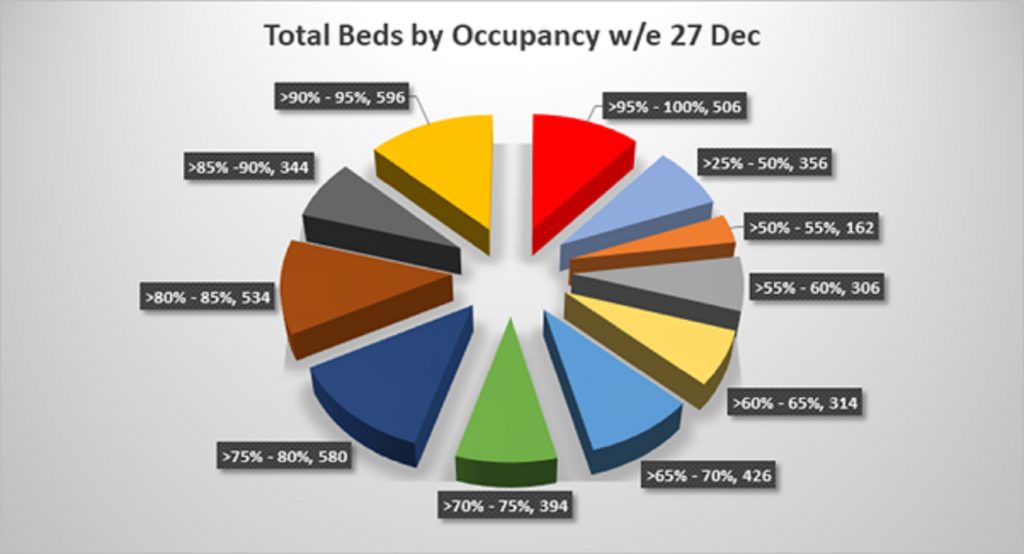
A Lockdown Sceptics reader has crunched the numbers on NHS critical care bed occupancy and sent us his analysis.
The Sunday Times published the list of critical care beds by NHS trust region, without too much drilling down. I’ve taken the trouble to do that. It’s based on NHS numbers. I looked at it because the article was provocatively titled “Already Full” without data backing it up.
They base the data on 4,518 beds, which would be Adult Critical Care Beds approximating to the 4,119 shown below so the data is quite robust. The occupancy data includes the likes of Christie, a specialist cancer hospital, so I guess there will be some beds that aren’t available for COVID-19 patients.

The Sunday Times report quotes x beds at y% occupancy. I’ve converted each hospital’s data to show the weighted equivalent beds, and then aggregated them regionally. I then use the weighted numbers in use with the total beds per region. I think that is a reasonable approach. National weighted utilisation is about 76% using this method

There are obviously some hospitals with critical situations, but no specific region is at 90% or more, with London the highest at 87%. I’ve looked at the categories of utilisation to see how many of the beds available are critically overloaded. I’ve identified 90-100% utilisation beds in amber and red below
Stop Press: The unavailability of critical care beds, then, is not yet a problem for the NHS, but a Spectator reader has a good idea what might be. He left a comment underneath an update from Katy Balls
We have enough critical care beds but not enough staff with 30 – 40% nurses off self isolating with a (probably false) positive PCR test. Instead of the usual couple of days off sick they now have 10 days minimum. Add to that the measures put in place to separate positive from negative patients and you have a self inflicted recipe for disaster. No one will ever now admit their earlier mistakes and will continue to double down on ineffective measures. The whole mass PCR testing and SAGE advice/affair is an economic catastrophe.
We now have recently vaccinated Drs off with a positive test but no symptoms.
Asymptomatic spread has now been shown to be a myth undermining the whole rationale for any lockdown.
You just have to ask why?
Letter From a Reader to His MP About Lockdown 3.0
Readers forward us so many letters that they’ve written to their MPs that we cannot publish all of them. But from time to time we’re sent a real humdinger. Below is one such, sent to Sir Iain Duncan Smith. If you’re thinking of taking up Peter Hitchens’s advice to write to your MP in advance of Wednesday’s vote, there are some good facts here you might be able to use.
Dear Sir Iain,
I hope you are keeping well. I have a couple of questions in respect of the government’s vaccination program/ongoing lockdown strategy (and its tragic impact) that I would be grateful if you could supply answers to.
Preamble: It has been scientifically established that COVID-19 is a low risk pathogen to most (group A), to such an extent that the majority who are infected suffer no symptoms, and that even for those who do suffer symptoms, they are generally mild/akin to flu.
It has also been scientifically established however that for a minority of primarily very elderly or unwell people (group B), COVID-19 presents a high risk pathogen that often proves fatal.
Question one: In the UK, group B consists of c.2.5M people, to which end why should some 30M or more people be vaccinated once the said 2.5M people have been?
Shelving questions of cost, necessity and disruption, it is important that people who don’t need vaccinations don’t have them as it enables their immune systems to develop a natural resistance to the pathogen in question, a resistance that may save them when its next variant inevitably besets them (such immunity preventing pandemics).
Moreover according to the ONS in the week to December 3rd alone 800,000 people in the UK were infected with COVID-19. Mindful of the fact that 70-90% of those infected with Covid show no symptoms, this would indicate that, even allowing for the well who got tested and whose infection was thus detected, some 4M+ of the UK population was infected in a given week, such that, allowing for the fact that the virus has been alive in our society now for an annum, surely it is only a matter of weeks before 30M people have either established a natural immunity to COVID-19 by dint of infection, or were always immune to it by way of past exposure to coronaviruses (last week 341,946 people were recorded by the ONS as having been infected, meaning, a la the same metric, a further 3M+ people were effectively immunised in just that seven day period).
Question two: In light of the fact that all of group B who wish it will be vaccinated by c. January 14th at the going rate, and that those not in this group have little to fear from COVID-19, and that tens of millions of people must already have had COVID-19 (or are immune to it by virtue of exposure to past corona viruses), why is it necessary to perpetuate lockdown measures beyond this date, measures that are both economically, socially and literally murderous? (Please see ref. below re the lockdown death toll).
This is not an idle question. As you are no doubt aware Bristol University, for one, has forecast that Parliament’s response to COVID-19 (as of early November, 2020) will ultimately kill 560,000 UK citizens, a figure more than twice that of the worst case Covid-death scenario of 250,000.
Similarly the ONS predicted earlier in 2020 year that Lockdowns and anti-Covid measures will kill 200,000 UK citizens of all ages in the medium to long term, due to missed medical diagnoses, missed treatments, loss of jobs, loss of tax revenue etcetera.
In line with these dire estimations, the 2020 death statistics (as tallied by the Institute and Faculty of Actuaries) indicate that of the 71,200 excess deaths recorded since the pandemic commenced, 46,721 of these must be attributed to lockdown measures – a rate of over 1000 people a week – which is nearly double the remaining 24,479 people who, according to the Institute, died during the same period due to COVID-19 (NB though 73,512 people died in 2020 with COVID-19, 66% of these would have died of other pathologies in 2020 anyway, as was freely admitted by Professor Neil Fergusson before the House of Commons Science and Technology Committee on March 25th, and thus would not figure in the 71,200 excess death figure for that year).
To conclude, setting aside human rights, civil liberties, Magna Carta and other, now apparently trivial issues (which two million British servicemen laid down their lives for), it can be safely taken that the unjust impositions placed upon the UK public, as well as ruining lives, livelihoods and the economy, are killing a thousand among our number a week at least, and thus must be lifted as a matter of urgency (and certainly not left in force until Easter, like some devilish Lent).
Thank you for your anticipated response.
Scotland Gets in First

The First Minister, as always, made sure she got her lockdown announcement in first, announcing it six hours before Boris announced his. The Scottish Sun has a summary:
The First Minister yesterday announced that the country would enter another full shut down.
There will be a legal stay-at-home order from 12am – just like last March – with £60 minimum fines for breaches.
She addressed Parliament yesterday and explained that the current situation was “extremely serious” – adding that the new variant of the virus was a “massive blow”.
Ms Sturgeon confirmed that vulnerable children and kids of key workers will still be able to go to school to ensure they are cared for.
She added that getting kids across the country back into classrooms will be a “priority” – and said that there will be a review later this month.
Churches and places of worship will be forced to shut, except for funerals and weddings.
A maximum of 20 people will be able to attend funeral services – with only five guests now allowed at weddings and civil partnerships.
She also confirmed that rules on non-essential businesses will be tightened further. Showrooms in retail outlets will be forced to close, while cosmetic and beauty outlets will not be able to operate.
Leisure venues such as ski centres which had been open until now will also have to shut in a bid to suppress the spread of the virus.
The SNP leader said government ministers would consult with businesses who have been hit by the latest wave of restrictions.
Worth reading in full.
As usual the Scottish lockdown is even more severe than the English one, closing both nurseries and churches which Boris has left open.
Stop Press: Police Scotland has unveiled a new online reporting tool so citizens can grass each other up for breaking lockdown rules without having to get up out of their armchairs.
Stop Press 2: Not wanting to be left out, Northern Ireland First Minister Arlene Foster has announced that her stay-at-home message is to be made law. Apparently, too many people were leaving their homes without a reasonable excuse. The nation is in week two of a six week lockdown. Sky News has the story.

 naufrage/sauvetage